
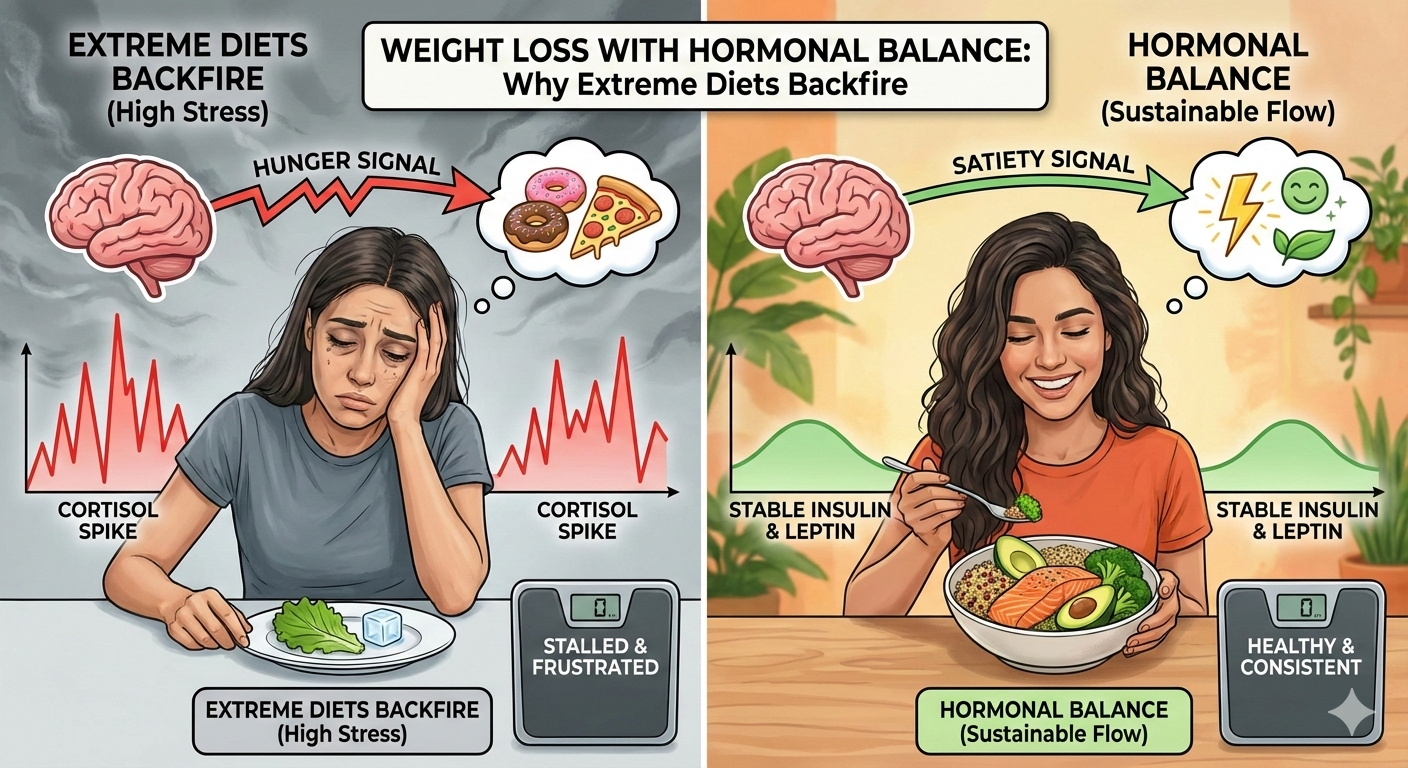
Ever felt like you’re doing “everything right” – counting every calorie, exercising till you drop – and still not seeing the scale budge? Or worse, feeling utterly exhausted and irritable? 😫 If this sounds familiar, you’re not alone. Many people approach weight loss with a “no pain, no gain” mentality, embracing extreme diets that promise quick fixes. But what if I told you that these drastic measures often backfire, especially when it comes to your delicate hormonal balance?
As a doctor, I see this pattern all the time. People jump on the latest restrictive diet trend, lose a few pounds initially, only to gain it all back (and sometimes more!) once the diet stops. Why? Because your body isn’t just a calorie calculator; it’s a complex symphony of hormones, and when that symphony is disrupted, everything goes haywire. 🎻🎶
Let’s dive into why extreme diets can mess with your hormones and what truly works for sustainable, healthy weight loss.
The Stress Hormone Storm: Cortisol ⛈️
When you drastically cut calories, skip meals, or engage in excessive exercise without adequate recovery, your body perceives it as a threat. And what does your body do when it feels threatened? It pumps out stress hormones, primarily cortisol.
Cortisol is essential for survival, but chronically elevated levels are a recipe for disaster when it comes to weight loss. High cortisol can:
-
Increase belly fat storage: Your body thinks it’s starving, so it holds onto energy (fat) in the most accessible place.
-
Break down muscle: Cortisol can be catabolic, meaning it breaks down precious muscle tissue, which is metabolically active and helps burn calories.
-
Increase cravings: Ever noticed how stressed you are, the more you crave sugary, high-fat comfort foods? That’s cortisol at play! 🍫🍩
The Science: Studies show that chronic psychological stress and physical stressors (like extreme dieting) can significantly impact cortisol levels, leading to metabolic dysfunction and increased fat accumulation.
The Thyroid Tango: Slowing Metabolism 🐌
Your thyroid gland is your body’s metabolic thermostat. It produces hormones (T3 and T4) that regulate how fast your body burns calories. When you go on a very low-calorie diet, your body tries to conserve energy to prevent starvation. How does it do this? By slowing down your metabolism! 📉
This often involves reducing the conversion of the less active thyroid hormone T4 to the more active T3. Your body effectively shifts into “energy-saving mode,” making it incredibly difficult to lose weight, even on minimal calories. You might also experience fatigue, hair loss, and cold intolerance. 🥶
The Science: Research indicates that severe caloric restriction can significantly decrease circulating thyroid hormones, particularly T3, leading to a reduction in resting metabolic rate.
Hunger Hormones Gone Wild: Leptin & Ghrelin 🎢
These two hormones are the master regulators of your hunger and satiety.
-
Leptin: Produced by fat cells, leptin signals to your brain that you have enough energy stored, suppressing appetite.
-
Ghrelin: Produced in the stomach, ghrelin tells your brain you’re hungry.
When you drastically cut calories, your body attempts to preserve its fat stores.
-
Leptin levels plummet: Your brain gets the signal that you’re starving, even if you still have plenty of fat. This triggers intense hunger.
-
Ghrelin levels surge: Your stomach is screaming for food, making those diet efforts feel like pure torture. 😩
This hormonal imbalance creates a vicious cycle where you feel constantly hungry, making adherence to extreme diets nearly impossible long-term.
The Science: Studies on the physiological adaptations to weight loss consistently show significant changes in appetite-regulating hormones, including decreased leptin and increased ghrelin, driving hunger and making weight maintenance challenging.
The Reproductive Repercussions: Estrogen & Progesterone 🩸
For women, extreme dieting can throw off the delicate balance of reproductive hormones like estrogen and progesterone. When your body is under chronic stress and perceives a state of energy deficit, it prioritizes survival over reproduction.
This can lead to:
-
Irregular or absent periods (amenorrhea): Your body essentially puts fertility on hold.
-
Reduced libido: Who has time for romance when your body thinks it’s in a famine?
-
Increased PMS symptoms: Hormonal chaos can exacerbate mood swings and physical discomfort. 😠
The Science: Energy deficit, often seen in extreme dieting or excessive exercise, is a known cause of functional hypothalamic amenorrhea, directly impacting estrogen and progesterone production.
What Actually Works: Gentle Nurturing, Not Extreme Measures 🌱
Instead of fighting your body, let’s learn to work with it. Sustainable weight loss comes from balancing your hormones, not just counting calories.
-
Prioritize Protein & Fiber: These keep you full, stabilize blood sugar, and support muscle mass. Think lean meats, fish, legumes, and lots of veggies. 🥦🍗
-
Embrace Healthy Fats: Don’t fear fats! Avocados, nuts, seeds, and olive oil are crucial for hormone production and satiety. 🥑🌰
-
Manage Stress: This is HUGE! Incorporate meditation, yoga, nature walks, or anything that helps you de-stress regularly. Your cortisol levels will thank you. 🧘♀️🌳
-
Quality Sleep: Aim for 7-9 hours of restful sleep. Sleep deprivation wreaks havoc on ghrelin, leptin, and cortisol. 😴
-
Smart Exercise: Focus on a mix of strength training (builds muscle, boosts metabolism) and moderate cardio. Avoid over-exercising, which can elevate cortisol. 💪🚶♀️
-
Hydrate: Water is essential for every bodily function, including metabolism. 💧
The journey to a healthier weight is not about deprivation; it’s about nourishment, balance, and tuning into your body’s wisdom. Ditch the extreme diets and start fostering a healthy relationship with food and your amazing hormones. Your body will thank you for it! ❤️
🔗 You May Also Find These Readings Helpful:
- [How to Eat More in Less Calories: Science of Smart Eating]
-
[Prakriti and Your Body: Why Some Struggle to Lose Weight While Others Struggle to Gain]
-
[Is a Calorie Deficit Enough for Fat Loss? Uncovering the Full Picture]
- [How Genetics Influence Belly Fat and How to Outsmart Them]

Akanksha Sharma
Dr. Akanksha Sharma, Head Writer and creator of AtoZ of Pregnancy, is dedicated to empowering women, parents, and families through 360-degree knowledge. She and her team provide evidence-based advice to guide families through pregnancy, parenting and beyond.



Leave a Reply