
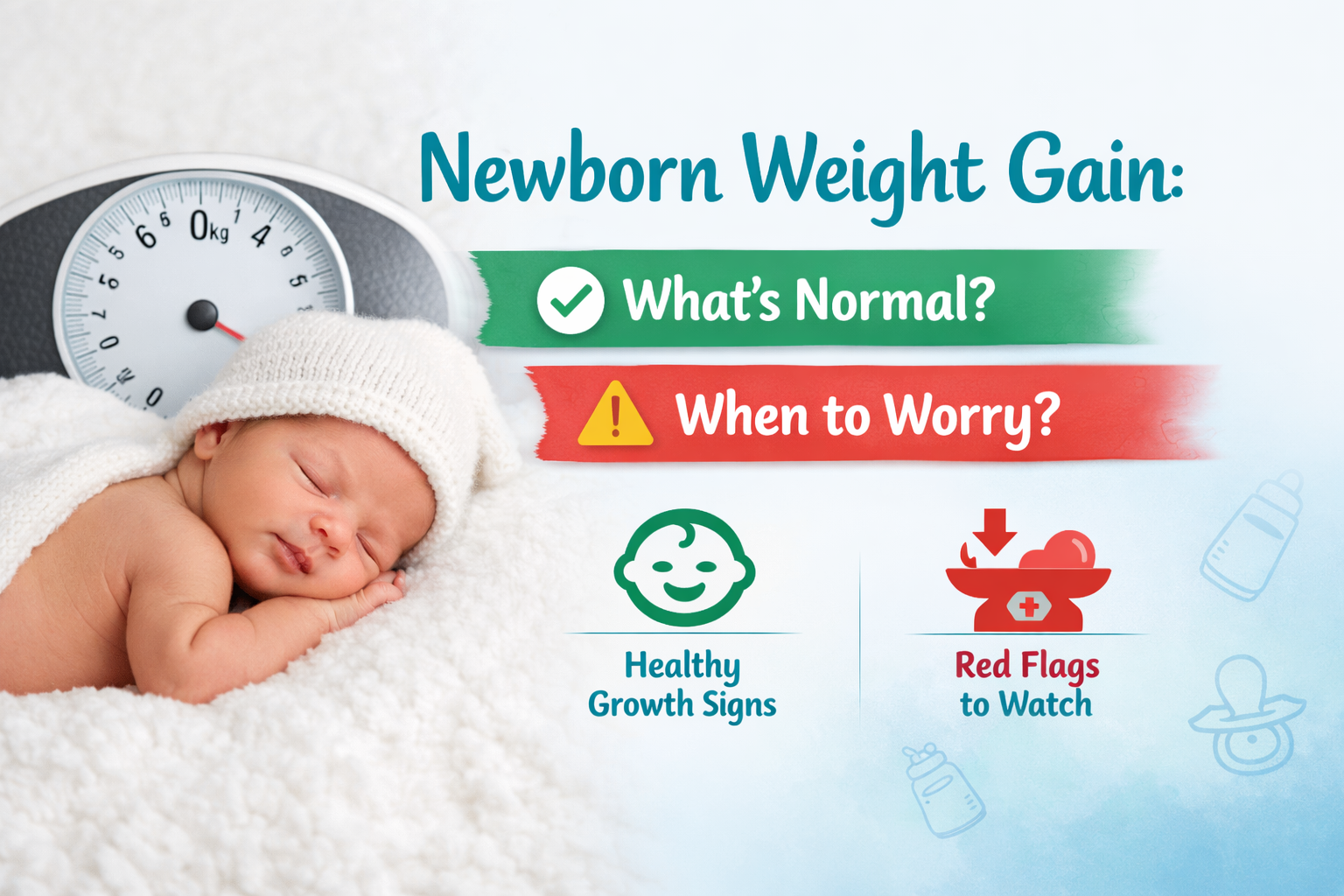
The moment a baby is born, one of the first metrics recorded is their birth weight. For the next several months, that number becomes a primary focus for parents and pediatricians alike. It is often viewed as the ultimate shorthand for a baby’s health and the success of a feeding journey. 🤱
However, infant growth is rarely a straight line. Between physiological weight drops and “growth spurts,” understanding the nuances of the scale can save parents from unnecessary anxiety. 🧘♀️ This guide breaks down the science of newborn growth, common pitfalls, and the clinical red flags you should know.
1. The “10% Rule”: Why Babies Lose Weight First 📉
It is a biological reality that almost all newborns lose weight in the first few days of life. Babies are born with extra fluid stores, and as they transition to life outside the womb—passing meconium and losing fluid—the scale will inevitably dip. 💦
-
What is normal: A weight loss of 5% to 7% is typical for most infants. ✅
-
The Threshold: A loss of 10% or more of birth weight is often the clinical threshold where healthcare providers will closely monitor feeding efficiency or suggest supplementation. ⚠️
-
The Goal: Most healthy newborns should return to their birth weight by 10 to 14 days of age. 🎯
Evidence Check: Research confirms that while weight loss is universal, the timing of the “nadir” (the lowest weight point) usually occurs around day 3.
2. Expected Weight Gain Milestones 👣
Once a baby regains their birth weight, they enter a period of rapid growth. While every baby follows their own “curve,” general benchmarks include:
-
0–3 Months: Average gain of 150–200 grams (5–7 ounces) per week. ⚖️
-
3–6 Months: Gain slows slightly to about 100–150 grams per week. 🍼
-
The Doubling Rule: Most babies double their birth weight by 5 to 6 months. 🎈
It is important to note that breastfed and formula-fed babies grow at different rates. Breastfed infants often grow more rapidly in the first 2–3 months and then lean out compared to formula-fed peers. 🧬
Clinical Insight: Growth charts (WHO vs. CDC) are essential tools. The WHO charts are based on breastfed infants and are the gold standard for children under age two.
3. Factors That Influence Growth 🔍
Several variables can impact how quickly a baby puts on ounces:
Feeding Efficiency 🤱
Is the latch deep? Is the baby active at the breast or falling asleep? In the fourth trimester, “sleepy babies” may not consume enough hindmilk (the high-fat milk at the end of a feed), which is crucial for weight gain. 😴
Gestational Age 🐣
Premature babies or those born “Small for Gestational Age” (SGA) may follow a different trajectory known as “catch-up growth.”
Maternal Factors 👩⚕️
Hormonal imbalances, such as untreated thyroid issues or Polycystic Ovary Syndrome (PCOS), can sometimes impact milk supply.
Evidence Check: Maternal metabolic health, including insulin resistance, can significantly influence early lactation success.
4. The “Output” Indicator: Watching the Diapers 💩
When the scale isn’t available, diapers are your best window into your baby’s intake.
-
By Day 5: Your baby should have at least 6 heavy wet diapers and 3–4 yellow stools per 24 hours. 💦🧷
-
If the urine is dark orange or contains “brick dust” (urates), it is a sign of mild dehydration and requires an immediate increase in feeding frequency. 🆘
5. When to Worry: Clinical Red Flags 🚩
“Failure to thrive” is a term used when a child’s growth is significantly below that of their peers. You should contact your paediatrician if you notice:
-
Failure to regain birth weight by week three. ⏳
-
A flat or descending growth curve across two or more consecutive checkups. 📉
-
Lethargy: A baby who is too tired to cry or too weak to suckle. 💤
-
Dehydration signs: Sunken soft spot (fontanelle), dry mouth, or crying without tears. 💧
6. Beyond the Scale: Holistic Health 🌟
Weight is just one piece of the puzzle. At Iysa Nutrition, we advocate for looking at the “Whole Baby.” Is your baby hitting developmental milestones? Are they alert during awake windows? Are they meeting their length and head circumference targets? 📏
Sometimes, a baby is simply a “small healthy” infant—genetically destined to be on the 5th percentile but following their curve perfectly. 😊
Final Thoughts for Parents 💌
If your baby is struggling with weight gain, it is not a reflection of your parenting. It is a clinical puzzle to be solved with your medical team. Focus on skin-to-skin contact, frequent feeding (8–12 times a day), and seeking early support from a lactation consultant or your GP. 👨⚕️🤝
Stop the 3 AM Google searches. 🛑 Are you navigating the Fourth Trimester? 🌸 Join our NURTURE Program for 1-on-1 doctor-guided support through your baby’s first 12 weeks of growth and your own postpartum recovery. 🤱✨
[Get the Free Guide on Fourth Trimester] [Book a Postpartum Consultation Today] 📅
Related reading:
👉What Postpartum Moms Should Know: A Comprehensive Guide
👉 Postpartum Nutrition: Doctor’s Insights for Optimal Recovery
👉7-Day Meal Plan for Postpartum Recovery: Traditional Indian Diet
👉Pregnancy & Postpartum Nutrition: A Doctor-Reviewed Guide

Akanksha Sharma
Dr Akanksha Sharma (MBBS, MD) is a physician and women’s health nutrition specialist, and the founder of Iysa Nutrition and IYSA Nutrition. She provides evidence-based, doctor-led guidance for pregnancy, postpartum recovery, PCOS, child nutrition, and family health, helping women make calm, informed decisions about their health and their children’s well-being.




Leave a Reply